

Pepducin Therapies to Treat Fibrotic and Metabolic - Inflammatory Diseases

We are a clinical-stage pharmaceutical company dedicated towards developing transformative therapies to treat patients with fibrotic - inflammatory diseases with a focus on MASH

About Us
Oasis Pharmaceuticals is developing first-in-class therapies based on its proprietary Pepducin™ technology which is designed to modulate Protease-Activated Receptor 2 (PAR2) and other recalcitrant GPCRs to address fibrosis, inflammation, and metabolic dysfunction across multiple diseases.
Our lead clinical candidate, OA-235i, is advancing into Phase 2 development for metabolic dysfunction–associated steatohepatitis (MASH), targeting fibrosis, lipid and glucose dysregulation, and hepatocellular injury.
Oasis is also developing an oral PAR2 drug to expand treatment accessibility and patient reach.
A topical agent, OA-3, currently in a 28 day Phase 1b trial in patients with atopic dermatitis, is in development to treat inflammatory skin diseases, leveraging selective PAR2 antagonism to reduce inflammation, pruritus, and skin barrier impairment.
Through the Pepducin™ platform, Oasis is building a broad, multi-indication pipeline with the potential to transform treatments in diseases of the liver, lung and skin.
Our leadership team is united by a shared passion for turning scientific breakthroughs into
real-world impact. Combining the vision of entrepreneurs, the curiosity of scientists, and
the compassion of physicians, we work together to bring novel therapies from concept
to the people who need them most.


Therapeutic focus on PAR2
Protease-Activated Receptor 2 (PAR2) is broadly expressed with critical roles across fibrotic and inflammatory pathways which supports opportunities in the treatment of MASH, atopic dermatitis, COPD, and idiopathic pulmonary fibrosis (IPF). This multi-system relevance positions PAR2 as a differentiated, high-value target with the potential to transform treatment in diseases of high unmet medical need.
.png)
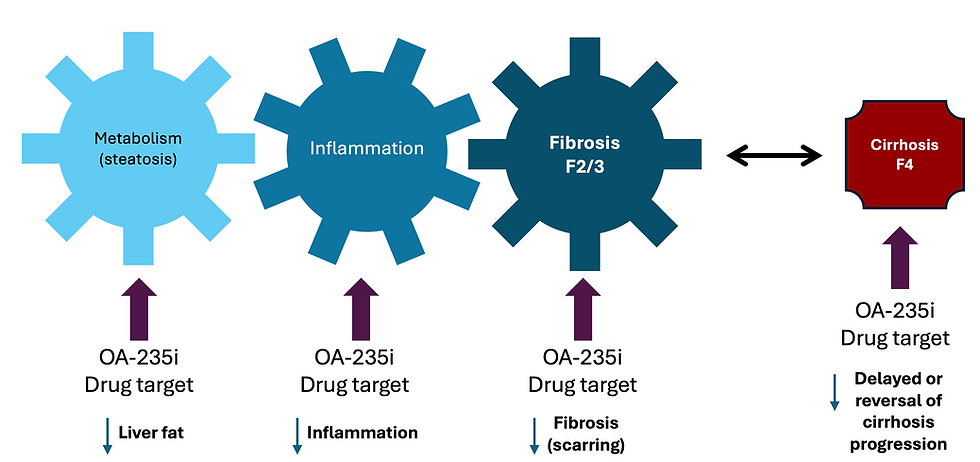
Multi-pronged attack on MASH
OA-235i is differentiated from single-target MASH therapies by acting at multiple steps in the liver fibrosis/cirrhosis process.
OA-235i reduces hepatic lipid accumulation while increasing HDL-cholesterol, and enhancing fatty-acid b-oxidation, improving overall energy metabolism. Simultaneously, OA-235i suppresses inflammatory signaling in resident liver inflammatory cells and directly inhibits fibrosis and collagen deposition of stellate cells. This leads to measurable improvements in liver function
and restoration of liver health.
Beyond hepatic endpoints, OA-235i demonstrates broad metabolic benefits, including improved glucose regulation and reduced insulin resistance. By inhibiting PAR2, the compound will support sustained weight reduction and long-term metabolic balance.
OA-235i's multi-pathway mechanism positions it as a potential first-in-class therapy capable of transforming outcomes in MASH fibrosis, metabolic syndrome. and related disorders.

Clinical Trials Evaluating OA-235i in MASH
Following successful completion of Phase 1a/b clinical studies in MASH/MASLD (n=24) [NCT05680233], OA-235i has demonstrated excellent safety, promising PK / pharmacodynamic / metabolic benefits — supporting advancement into Phase 2 clinical development.
Overview
-
Innovative lipopeptide with high liver-partitioning properties for sustained anti-fibrotic/metabolic benefits
-
Phase 1 complete — safe, well tolerated, with target engagement
Phase 1a/b Highlights
-
Safety: Mild AEs only; no GI issues, no serious events
-
Glucose: Dose-dependent blood-glucose lowering
-
Lipids: ↑ HDL cholesterol, ↓ triglycerides — effects lasting up to 14 days
-
PK/PD: high drug levels, prolonged exposure, supports infrequent dosing
Next Steps
-
Advancing to Phase 2a → 2b/3 trials
-
Focus on non-invasive liver stiffness and histological endpoints
Positioning
-
Strong foundation for metabolic and additional liver-health indications
-
Differentiated mechanism, durable efficacy, clear path to strategic partnering

Clinical Trial Evaluating OA-3 in AD (atopic dermatitis) patients
OA-3 is a first-in-class topical that selectively antagonizes PAR2, a critical regulator of inflammatory signaling, pruritus, and epithelial barrier impairment in human skin. Following successful completion of Phase 1a clinical studies in healthy volunteers, OA-3 has demonstrated excellent safety/tolerability with no AEs and has advanced into a 28-day repeat dose Phase 1b trial in atopic dermatitis patients. The compound’s targeted mechanism unlocks a novel therapeutic pathway with broad applicability across inflammatory skin diseases, providing a compelling platform for clinical advancement and commercial differentiation.

Respiratory
Idiopathic Pulmonary Fibrosis (IPF)
OA-235i is being developed as a disease-modifying approach to treating fibrotic lung diseases by targeting PAR2-mediated activation of lung fibrotic pathways
Idiopathic Pulmonary Fibrosis is a progressive and fatal lung disease characterized by persistent fibroblast activation, excessive extracellular matrix deposition, and irreversible loss of lung function. Current therapies slow disease progression but do not directly address the core, persistent signaling pathways that drive fibrosis. PAR2 has been identified as an upstream amplifier of profibrotic biology, including activation of TGF-β and SMAD signaling in lung fibroblasts. In fibrotic lung tissue, this pathway contributes to sustained myofibroblast differentiation and pathological tissue remodeling.
OA-235i inhibits intracellular PAR2 signaling induced by various lung proteases, suppressing fibrotic responses at their source
By targeting a central, disease-driving mechanism, OA-235i has the potential to complement or improve upon existing treatment approaches.
Chronic Obstructive Pulmonary Disease (COPD)
COPD is characterized by excessive protease activity, including neutrophil elastase and eosinophil PRSS33 which aberrantly activate PAR2 and amplify inflammatory and tissue-destructive signaling. OA-235i targets PAR2 upstream in the inflammatory cascade to interrupt this chronic protease-driven feedback loop, with the potential to modify disease progression rather than provide symptomatic relief. OA-235i is well positioned as a potential first-in-class disease-modifying therapy for COPD.

CNS
Stroke/CAD
OA-400 is a first-in-class therapy in development for acute ischemic stroke and coronary artery disease (CAD) that combines dual antiplatelet activity with direct neuronal protection via GPR31 targeting, addressing both thrombotic and neural injury in CNS ischemia.

Media
MASH - TAG
January 8-11, 2026 Park City, Utah
In Jan 2025 at Park City, Presented Distinquished Oral Presentation on First-in-human phase 1 study of the safety and pharmacodynamic effects of OA-235i, a PAR2 Pepducin in adults with MASLD and MASH
https://www.mashtag.org/videos/2025/day-2-pm [starting at 32 min:10 sec – 46 min:34 sec]
AASLD Meeting
November 5-9, 2025 San Diego
Presented
First-in-human phase 1 study of the safety and pharmacodynamic effects of OA-235i, a PAR2
pepducin, in adults with metabolic-associated steatotic liver disease (MASLD) and steatohepatitis (MASH)

International Stroke Conference
Feb 4 - Feb 7, 2025 Los Angeles
Presented Oral Presentation on Developing OA-400 as a treatment of ischemic stroke
Preclinical Papers
PAR2 Pepducins in MASH, Fibrosis & Inflammation
Coagulation protease-activated receptor-2 (PAR2) promotes dyslipidemia, obesity and MASLD through repression of the hepatic pioneer factor HNF4a
Chen X., Nguyen, N., Turner S.E., Tai A.K., Abdelmalek M.F., Covic L., Kuliopulos A. JHEP Reports 2026
DOI: https://www.sciencedirect.com/science/article/pii/S2589555926000674
PAR2 promotes impaired glucose uptake and insulin resistance in NAFLD through GLUT2 and Akt interference
Shearer A.M., Wang Y., Fletcher E.K., Rana R., Michael E.S., Abdelmalek M.F., Covic L., Kuliopulos A. Hepatology 2022
Targeting Liver Fibrosis with a Cell Penetrating Protease-activated Receptor-2 (PAR2) Pepducin
Shearer A.M., Rana R., Austin, K., et al. J Biol Chem. 2016
Lipopeptide Pepducins as Therapeutic Agents
Michael E, Covic L, Kuliopulos A. Methods Mol Biol. 2022
PAR2 controls cholesterol homeostasis and lipid metabolism in nonalcoholic fatty liver disease
Rana R., Shearer A.M., Fletcher E.K., Abdelmalek M.F., Covic L., Kuliopulos A. Molecular Metabolism (2019)
PAR2 Pepducins in Atopic Dermatitis
PAR2 Pepducin-Based Suppression of Inflammation and Itch in Atopic Dermatitis Models
Barr T., Garzia C., Guha S., Fletcher E., et al. Journal of Investigative Dermatology. 2019
Targeting PAR2 with Pepducins
Melissa S. Lee & Ethan A. Lerner. Journal of Investigative Dermatology. 2018
GPR31 Anti-stroke/thrombotic Pepducin
Lipid Receptor GPR31 (G-Protein Coupled Receptor 31) Regulated Platelet Reactivity and Thrombosis Without Affecting Hemostasis
L Van Doren, Nguyen N, Garcia C, Fletcher E.K., Stevenson R., Jaramillo D., Kuliopulos A, Covic L. Atheroscler Thromb Vasc Biol. 2021
DOI: https://www.ahajournals.org/doi/10.1161/ATVBAHA.120.315154
Clinical Papers
Phase 1 and Phase 2 Clinical Trials with PAR1 Pepducin
PAR1 Pepducin Therapy Targeting Myocardial Necrosis in CAD and ACS Patients Undergoing Cardiac Catheterization: A Randomized, Placebo-Controlled, Phase 2 Study
Kuliopulos, A., Gurbel P.A, Rade, J.J. et al. Atheroscler Thromb Vasc Biol. 2020
Cell-Penetrating Pepducin Therapy Targeting PAR1 in Subjects with Coronary Artery Disease
Gurbel P.A, Bliden K.P., Turner U.S., Gesheff M.G. et al. Atheroscler Thromb Vasc Biol. 2016
Leadership Team
.png)
Athan Kuliopulos,
MD PhD
CEO
Co-founder of Oasis Pharmaceuticals and co-inventor of pepducin technology. He is a serial biotechnology entrepreneur with extensive experience translating novel
discoveries into innovative therapeutics. Dr. Kuliopulos is a physician-scientist who trained at Johns Hopkins and Harvard School of Medicine as a Judith Graham Pool Fellow. He was elected to the American Association of Physicians, and has received numerous awards and recognition.
.png)
Lidija Covic
PhD
CSO
Co-founder of Oasis Pharmaceuticals and co-inventor of pepducin technology. Dr. Covic is an
internationally recognized expert in PAR2 biology, inflammation, and disease pathophysiology. She previously founded Ascent/Anchor Therapeutics along with Dr. Kuliopulos and served as Senior Scientific advisor.
.png)
John Amedio
PhD
VP , CMC
Dr. Amedio is an expert in peptide manufacturing, injectable and oral drug development, and
global CMC strategy. He has contributed to the development and regulatory approval of multiple
medicines in the United States and Europe.
.png)
Tim Rolph
DPhil
Strategic and
Scientific Advisor
Dr. Rolph is an accomplished biotechnology leader with extensive experience in metabolic,
cardiovascular, and liver disease drug development. He founded Akero Therapeutics where he served as CSO, and
previously led cardiovascular and metabolic research and development at Pfizer. Dr. Rolph recieved his DPhil at Oxford University.
.png)
Susan Turner
BS
Director of Clinical
Trials
Susan Turner has more than 20 years of experience designing and executing Phase 1 through
Phase 3 clinical trials. Her expertise includes clinical operations, drug development strategy,
and FDA regulatory affairs.
.png)
Dana Minnick
PhD
Regulatory
Dr. Minnick has more than 20 years of experience in regulatory affairs and global drug
development. She has supported the development and approval of more than 30 medicines
across metabolic, cardiovascular, and oncology indications.
.png)
Manal Abdelmalek
MD
Hepatologist & Clinical Director
Dr. Abdelmalek is an internationally recognized hepatologist and clinical investigator specializing in MASH and advanced liver disease. She has more than 30 years of clinical and research experience and has authored over 200 publications in hepatology.